
A participant has saved several versions of a report in Word. The course also uses text comparison. Do you additionally need writing-session information? Imagine that the conclusion changed between two versions. First, you want to know why. The draft lets you discuss the change; an additional recording is not automatically necessary.
It is different when you have a signed record and need to check whether it belongs to the submitted file. File binding helps here. The following sections explain which questions each type of evidence can address. We have not conducted a comparative product test.
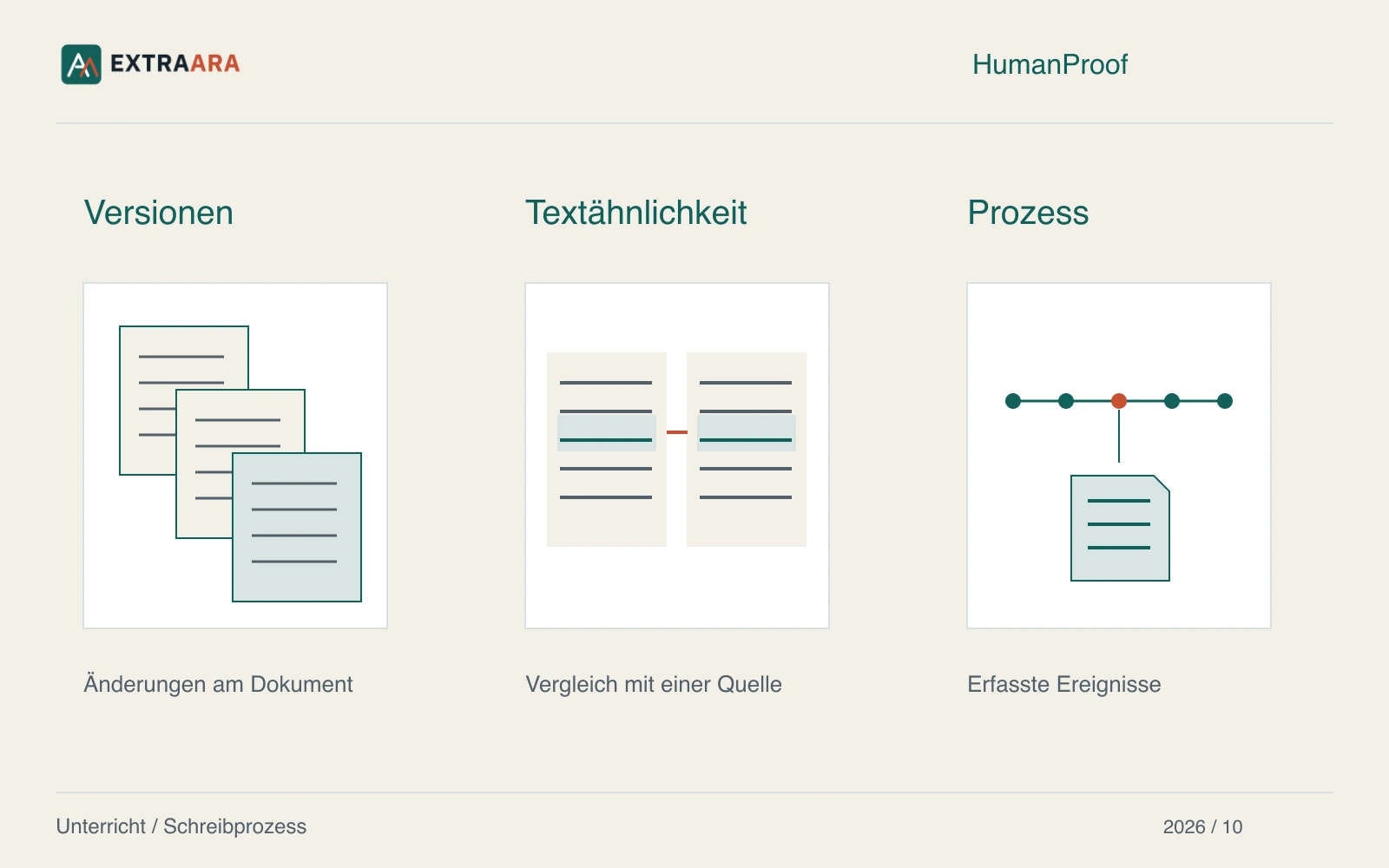
Version history helps explain changes to a text
An early version has a different conclusion from the final report. That gives you a concrete starting point for feedback: why did you change your decision? Ask for an explanation using the relevant passage. Version history reveals the change; you need to discuss its reasoning with the person.
Microsoft’s version history in Microsoft 365 applies to files stored in OneDrive or SharePoint. Check how your environment retains versions and who can access them. The history shows the versions the system holds. It does not automatically describe every note, external tool or activity between saved versions. If you want to discuss a particular draft, establish beforehand which documents must be retained.
Text comparison takes you back to the relevant passages
A similarity report points to a passage also found in another source. Read the passage first, then open the source. Is the borrowed wording clearly quoted? Does the reference match the source? Matching wording can have very different explanations. A match alone does not show how someone developed their argument.
Sunet’s service Inspera Originality compares submitted texts with sources and produces an analysis report. Sunet describes the report as a basis for subsequent assessment.
Read process evidence within its recording boundaries
A tool that records writing activity can reveal parts of the work between drafts. Turnitin Clarity describes a Writing Report with a timeline and information about pasted text within its writing environment. Cadmus also describes reports on activity during assignment work.
Before using a tool, review its recording scope. Its documentation should answer these questions:
- Which application or writing area is observed?
- How is text that existed before the session identified?
- What can be said about interruptions, and which work remains unobserved?
- Who can access the text and session information?
ExtraProof’s Creation Record documents the observed session. Cryptographic verification can show whether signed information is unchanged. On its own, it confirms neither the truth of every observation nor that all work on the document was captured.
File binding checks whether the exact same bytes are present
Two PDFs can have the same name and appearance but contain different bytes. Exporting again can also change a file. The filename alone is therefore weak evidence of which version a record relates to. If an ExtraProof record contains a file binding, the recipient can compare the file’s fingerprint with the signed value. A match means the checked file matches the binding. Without a file binding, this comparison is unavailable.
Signature and identity are separate questions too. A valid signature can belong to a locally generated key whose owner has not been independently confirmed. The ExtraProof trust documentation explains this distinction.
Start with the question that matters to your assessment
Write down what you want to understand before requesting more information. The table helps narrow the question. It does not describe an automatic decision about someone’s work.
On small screens, the table can be scrolled horizontally.
| Your question | Possible evidence | What remains unresolved |
|---|---|---|
| How was the argument changed? | Drafts or version history | The explanation for the change |
| Where did this passage come from? | Text comparison and source | Quotation, reference and context |
| What was captured in the session? | Process record | Recording boundaries and gaps |
| Does the record apply to this file? | Signed file binding and comparison | Trust in the key and observations |
Start with the evidence already available. If an important question remains, you can assess additional recording in a limited trial. Record whether a teacher could derive a useful follow-up question and how long the review took. A longer report is not inherently a better result. None of these checks alone proves human authorship or the absence of AI.